About the site
The site comprises part of the former Chaucer Technology School which closed in 2015. The school buildings have since been demolished and the site comprises an area of scrubland, including the former school car park to the south. The boundaries of the site are mostly areas of foliage and tree planting.
The site is located within a predominantly residential area with the majority of the surrounding buildings being 2-3 storeys, brick and tile construction. Within the immediate context, there are several 3 storey, flat roof structures that surround the site.
The former Chaucer School site forms part of a draft allocation in the emerging Canterbury District Local Plan, which has an indicative capacity of 70 homes. These emerging proposals would seek to deliver part of this allocation.
Please see the wider context in more detail below:
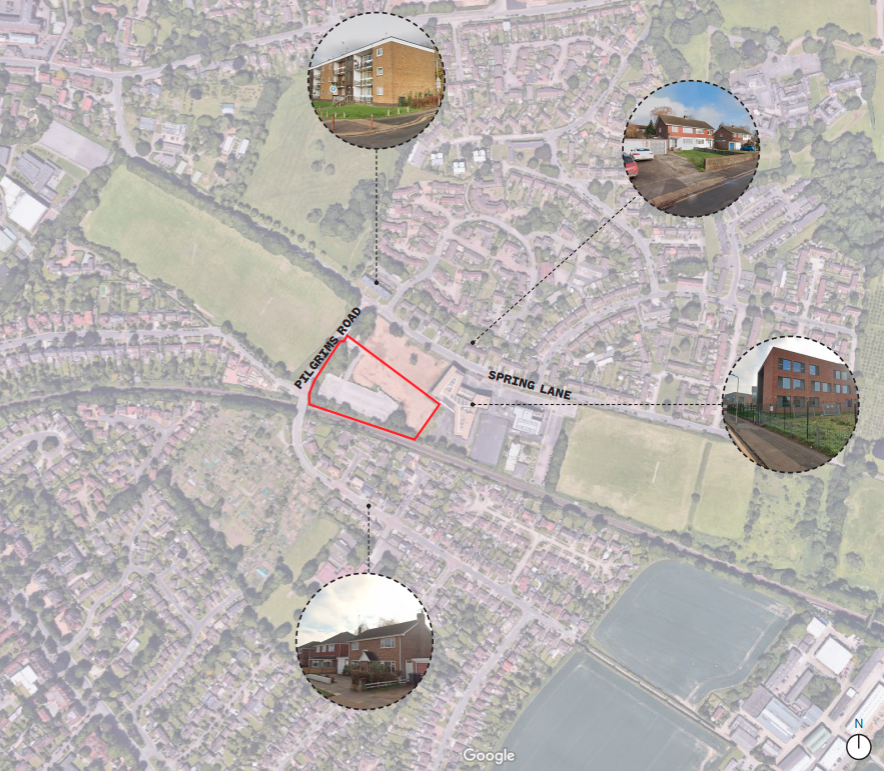
Above: the site in red
The site is bounded by the Canterbury to Dover railway line to the south and Barton Manor School to the east. To the north is Spring Lane, with a residential area beyond it, and to the west is Pilgrims Lane.
The closest train station is Canterbury East, which is a 5-minute drive, and the site is approximately 1km from Canterbury City Centre. The site is also not located in a Conservation Area and is not subject to any other environmental restrictions.
Please see below photos from around the existing site:
.png)
Our Vision
The emerging proposals are for a residential development of 34 new houses, including 28 three-bed and six two-bed homes.
Please see below a masterplan of the proposals.
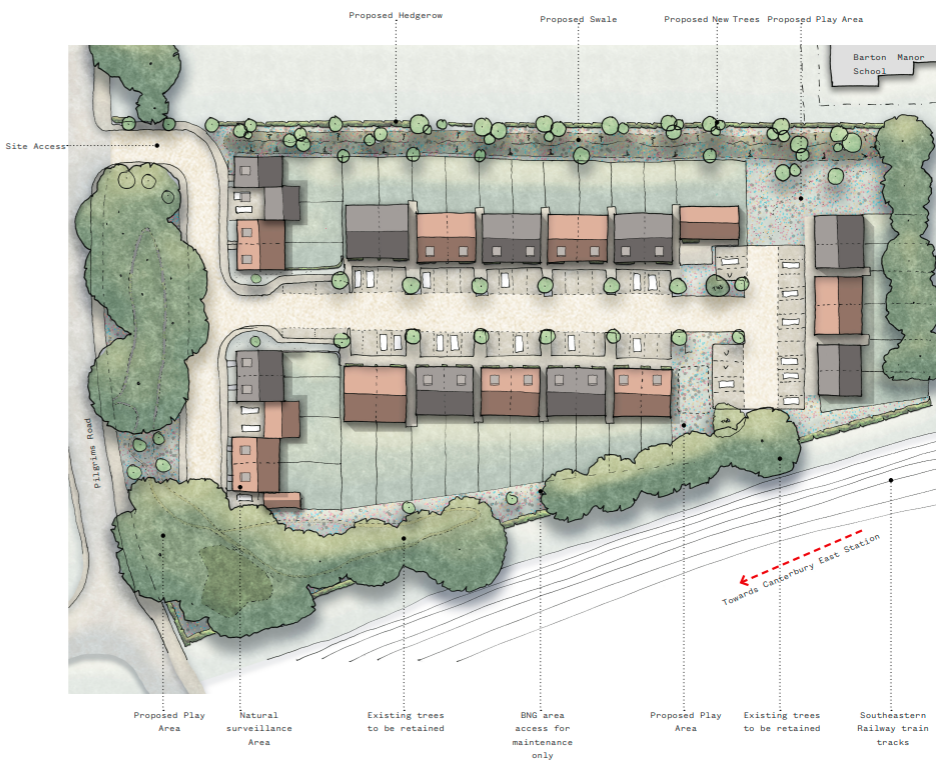
The proposal delivers 34 new homes and ensures consistency with the surrounding neighbourhood character.
The masterplan (above) has been shaped to reflect and reinforce the character of Canterbury, taking inspiration from the spatial arrangement and scale of nearby residential properties.
At the site entrance (located off Pilgrims Road), seven homes will create an attractive and welcoming frontage, supported by three shared carports that serve these homes.
Across the wider site, the layout balances efficient land use with sensitivity to the existing context, ensuring that the size of the new homes is in keeping with the surrounding area.
Each home provides high-quality, family-oriented accommodation with dedicated parking. Accessibility is also a key consideration, with all homes designed to be inclusive for visitors regardless of mobility.
Community and safety are embedded in the design through natural surveillance. Notably, the home at the site’s bottom left edge overlooks the designated green landscaping area, which will be secured for ecological enhancement and accessed only for maintenance.
Existing mature trees along the boundary with the Southeastern railway line are to be retained, supporting both ecological value and visual screening, while additional tree planting within the site further enhances landscape character.
To the north of the site, sustainable drainage features will be put in place in the form of new trees, hedge planting, and green-sloping features. This will help to manage rainwater run-off within the site and add additional environmental benefits as part of a landscape led and resilient approach to design.
Unit mix:
The proposed development provides a total of 34 residential dwellings across the site, carefully designed to create a varied yet balanced housing mix.
The accommodation comprises of:
- Seven three-bed homes in a row parallel to Pilgrims Road over 2.5 storeys (marked with blue and black spots below). These properties will be connected by three garage-like structures for car parking.
- Four semi-detached three-bed homes over 2 storeys high, marked with orange.
- 16 semi-detached three-bed homes over 2.5 storeys high, marked with light pink.
- A detached three-bed over 2 storeys high, marked with dark pink spots.
- Six semi-detached two-beds over 2 storeys, labelled 15-20 on the below sketch.
Here is a birds-eye sketch of the housing mix:
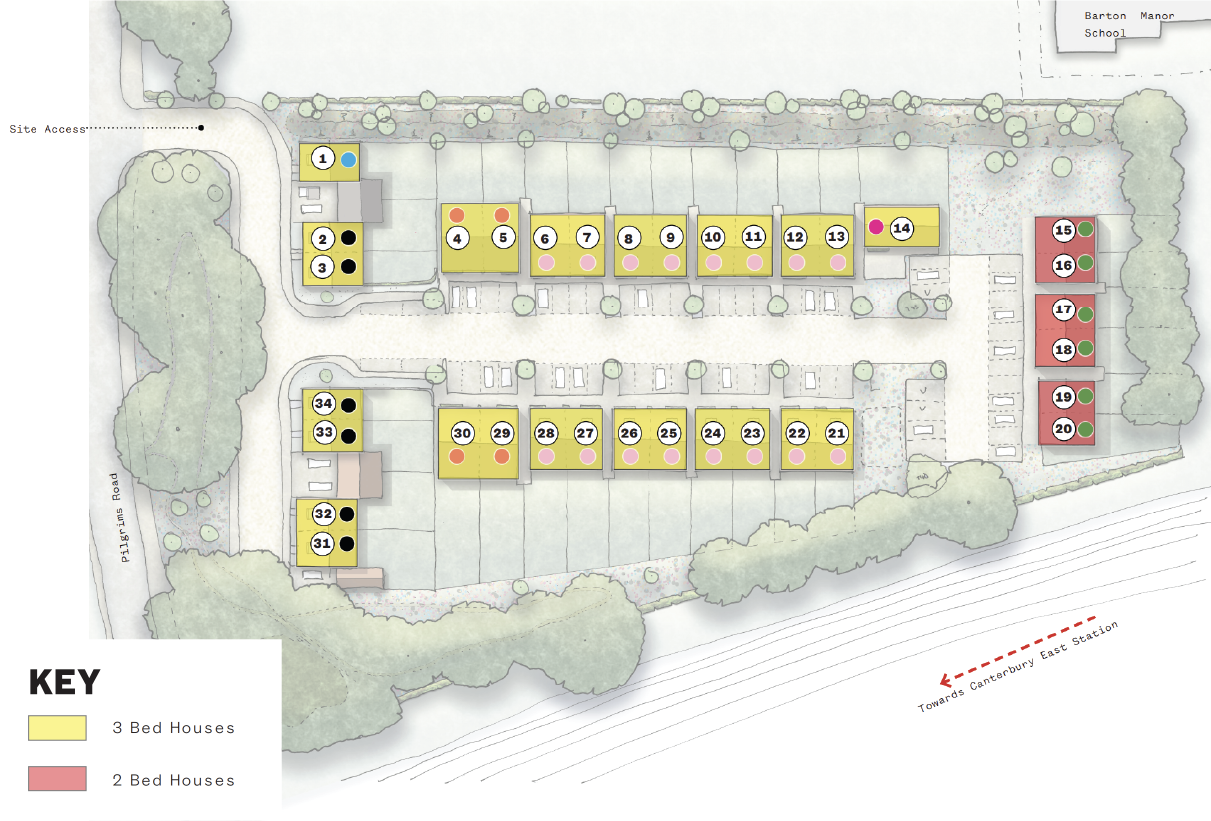
The above arrangement ensures a choice of family homes of different sizes and forms, supporting a diverse community while remaining consistent with the established residential character of the surrounding area.
The distribution of unit types has been informed by the site layout and masterplan principles, with the houses closely following the shape of the internal street.
Views of the emerging proposals:
We have prepared some sketches of how the buildings will appear from a couple of vantage points:
Firstly, a sketch of the proposals from the internal street looking east, away from Pilgrims Road.
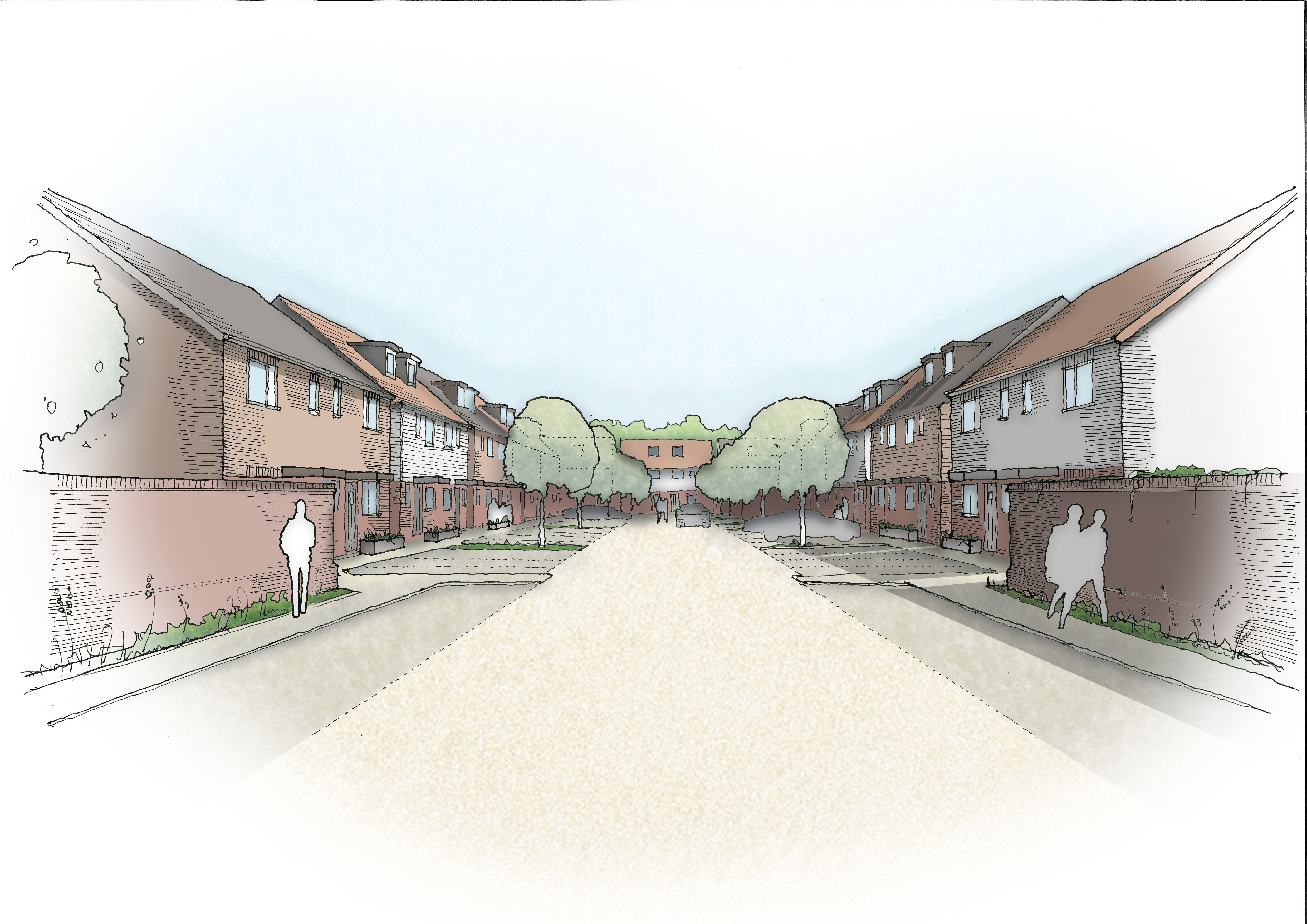
Above: view from the internal street
Next, a bird-eye sketch of the proposals looking south.
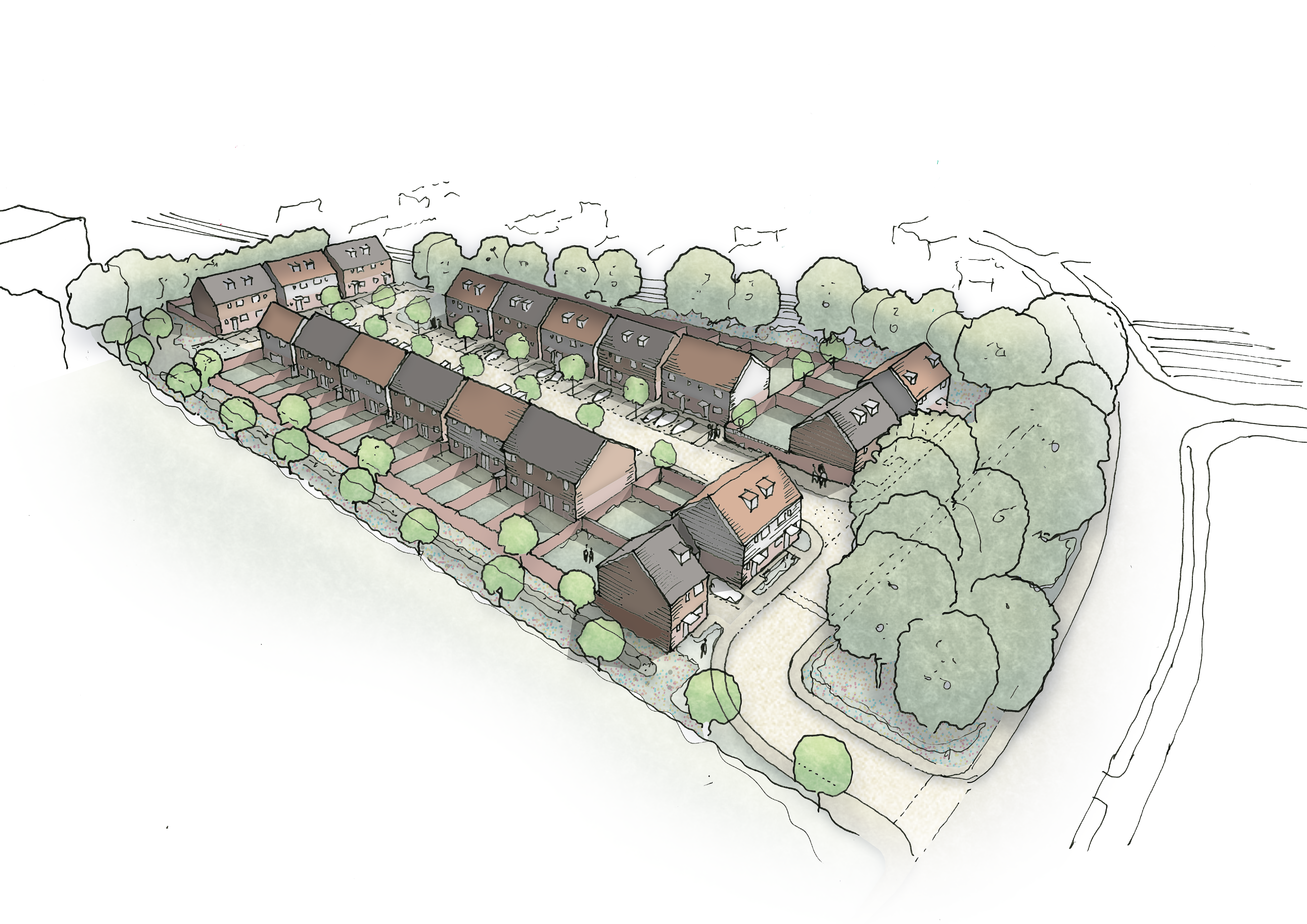
Above: aerial view
Architectural treatment:
The scale of the proposed development has been carefully considered to ensure it is appropriate in relation to the surrounding context.
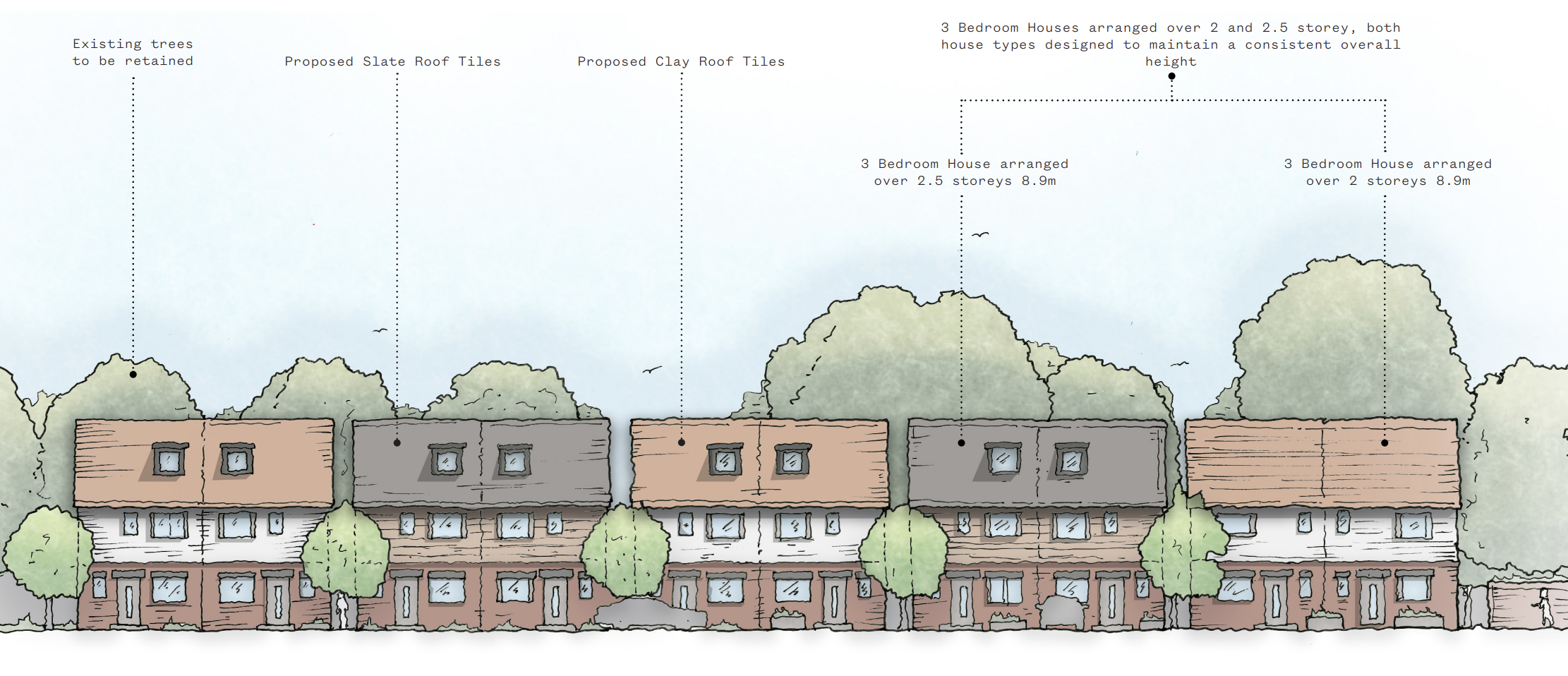
The scheme introduces a mix of homes ranging from two storeys to 2.5 storeys in height, with the upper floor of the taller homes accommodated sensitively within the roof space.
This design approach reduces the visual impact of additional height and ensures the overall roofline remains consistent and harmonious across the site.
Both the two-storey and 2.5-storey homes reach an overall height of approximately 9 metres, ensuring a balanced roofscape and avoiding abrupt changes in scale.
The two-bedroom homes are designed to be slightly lower at around 8.5 metres, providing subtle variation while maintaining a cohesive appearance within the street scene.
Similarly, the detached three-bedroom dwelling has also been designed at approximately 8.5 metres, reinforcing this sense of consistency across the development.
We have prepared the below street elevation sketch of the 10 three-bed semi-detached houses that lie parallel with the Southeastern railway tracks behind. This demonstrates the sensitive design elements of our proposals.
Sustainability
A number of sustainability measures will form part of these emerging proposals. It is proposed that these may include solar panels, EV charging points (at least one per home) and Air Source Heat Pumps.
Conclusion:
We are looking to bring forward a landscape led regeneration of 34 new homes in an accessible location, on part of the former Chaucer Technology School site. Our scheme is a fantastic opportunity to revitalise this disused site for the local community, with the vital benefit of delivering much needed housing to Canterbury.
We welcome your views on these emerging proposals, please click the button below to share your thoughts. Thank you for your interest.
 Back to home page

.png)